A year on since the mega modular treatment plant at Loch Ness Regional Water Treatment Works (WTW) reached water into supply and following successful commissioning, our teams have been sharing the achievements and lessons learned of the project with RSE graduates.
RSE’s delivery of the new Loch Ness WTW follows several years of successful collaboration with Scottish Water to develop nanofiltration membrane plants housed within Transportable Treatment Units (TTUs), including the award winning Lochmaddy WTW that was part of a £15 million investment to improve local water supply.
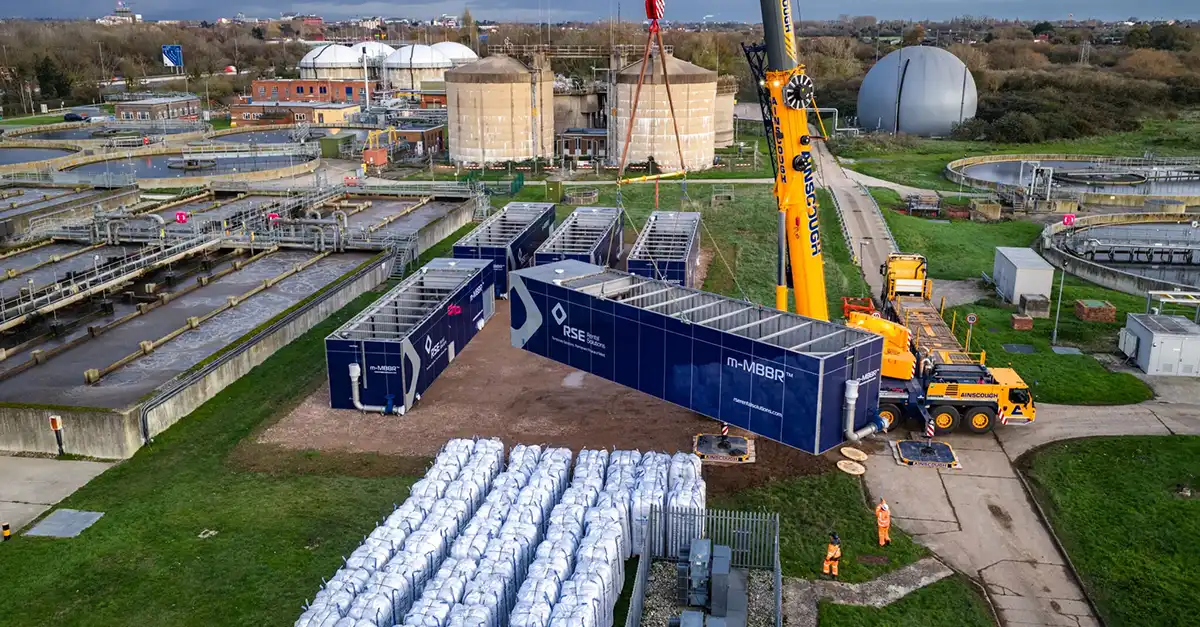
Throughout the Loch Ness WTW project, RSE teams seamlessly managed the design, build, installation, and commissioning of the modular WTW building, consisting of 12 No. TTUs and housing innovative nanofiltration membrane technology. Each of the TTU modules were expertly fabricated in our state-of-the-art Muir of Ord production facilities, with the dosing skids manufactured by our Chemical Dosing division in Dalgety Bay and the complete fit-out of the modular building occurring in our specialised assembly facility, additionally located in Muir of Ord.
Loch Ness WTW is a 1000m3/day nanofiltration membrane plant with sodium hypochlorite and ammonium sulphate disinfection, limestone media remineralisation, MSP plumbosolvency protection and sodium hydroxide pH correction. The works also has a fully integrated state of the art PROFIBUS network and SCADA system – all of which has been developed and installed in-house by RSE.


The Motor Control Centre (MCC) was manufactured by RSE subsidiary control systems specialist, Saftronics, and delivered to Muir of Ord for installation within the modular building. To ensure a smooth transition to site and minimise any operational complications, the mega modular building underwent comprehensive commissioning in our workshops before being transported and delivered to site.
The delivery of this project presented a variety of challenges which tested the capabilities of our team and required innovative water treatment solutions to be implemented. One of the main complications faced by the project team was the extremely tight site footprint, requiring the design team to redesign the WTW to be split over two levels to maximise the space available. This created some hydraulic challenges as the team had to ensure there was no unnecessary pumping required.
The Loch Ness WTW project, which started in 2018, was also affected by the implications of the COVID-19 pandemic and subsequent working restrictions. This posed risks to the timely delivery of the project as traditional working procedures were no longer a possibility. However, the site team were able to adapt their operations and ensured compliance with government regulations using specific Risk Assessment Method Statement (RAMS) and adaptations to traditional working procedures.


The team were additionally challenged to build the new modular building in isolation to the existing WTW as a way of allowing operations to continue as normal until the point of switch over. The offsite-manufacturing nature of the WTW delivered by RSE allowed for certainty and savings in time, cost, resource, logistics and carbon emissions. In addition, by completing the mechanical and electrical fabrication and installation in our specialised workshop, only 15% of the total project hours were spent on site, which greatly improved the cost, health and safety and carbon performance of the project.
The soft water source of Loch Ness had the potential to impact the final water quality due to its aggressive nature, as a result of having very little mineral content. Consideration therefore had to be given to the water treatment process to transform the soft water to moderately hard water in order to improve the final water quality. A complex limestone contact remineralisation with semi-automated cleaning system was designed to ensure this issue was resolved.
Our teams are proud of the works delivered for Loch Ness WTW, with RSE completing the project hitting programme and budget targets and with water into supply commencing in July 2022. The project also allowed for valuable training opportunities to be provided to our upcoming talent, with 26 apprentices having contributed over 8,000 hours in total to the project’s delivery. The innovative solutions to the problems faced during the completion of the project have helped to ensure that the communities surrounding Loch Ness, including Invermoriston and Fort Augustus, will now have a reliable and clean water source secured for the future.
Loch Ness WTW Quotes from Key Stakeholders

A mix of new technologies, digital approaches and ingenuity have driven this project and enabled it to overcome some significant challenges. By working closely with the Highland Council, local businesses, and communities, we hope that we have left a positive legacy, both in terms of what has been built and the way it has been achieved. Most importantly, we have enabled customers to be supplied with clear, fresh, and great-tasting drinking water on a sustainable basis for decades to come.
Mark Dickson, Scottish Water Director of Capital Investment

The Loch Ness project has encountered many challenges along the way, but the team has managed to achieve excellence in delivery – and in a way that is sustainable and sensitive to the outstanding natural landscape and the local communities. This is all down to the combined efforts of the Scottish Water team, ESD, key supplier RSE, and local supply chain companies, including many from the Highland region.
Wendy Cooper, ESD Chief Operating Officer
Our work with Scottish Water on this project has helped to provide RSE with a strong and sustainable foundation, providing the opportunity to grow our business. Our workforce of 1500+ employees is now spread across our facilities in Inverness, Muir of Ord, Cumbernauld, Dalgety Bay, Dewsbury, Basingstoke, and London, all of which are linked back to our head office and manufacturing facility in the Highlands where approximately 340 members of our team are based.
A crucial component of our plan for the future is the development of our team. Our RSE Apprenticeship Scheme is supported by Highlands and Islands Enterprise and Skills Development Scotland, with 67 apprentices currently training. Our apprentices range in age from 17 to 33 and cover various trade disciplines including Mechanical Fittings, Electrical Installation, Fabrication/Welding, Machining and Pipefitting.
We continue to seek to expand our apprentice workforce and offer new career opportunities with the local community. We additionally have 72 graduates currently on our RSE Graduate Programme, including graduates from the University of the Highlands and Islands.
Allan Dallas, RSE Operations Director
RSE Graduate Site Visit – Loch Ness WTW
Following the completion of the project, a selection of our 2021 cohort of graduates were given the opportunity to attend a group site visit to Loch Ness WTW.
The graduates’ visit was led by RSE ICA Manager, Mark Dallas, who gave a guided tour of the mega modular building to enable the graduates to learn more about the design, fabrication, and installation of the project and to ask any questions about the water treatment processes utilised within the plant.
For several of our engineering and support function graduates, the site visit was the first time that they were able to walk round a fully operational water treatment works, which allowed them to put their knowledge into context and gain a clearer understanding of the engineering practices facilitated by RSE teams for the project.
The graduates found the site visit very insightful, with future visits planned for our other RSE Graduate Programme cohorts:


For someone who works outside of the process discipline, the tour was very informative. It was a great opportunity to give office-based staff a better understanding of the services and capabilities RSE provides to our clients. Mark was very knowledgeable and more than willing to answer any questions that we had
Ross Carroll, RSE Civil Engineer
As part of my role at RSE I don’t tend to visit sites regularly, so it was interesting to visit a completed and operating water treatment works. It helped improve my understanding of the different engineering disciplines that work together to deliver this kind of project and it was useful to have experienced different stages of a Transportable Treatment Unit (TTU) lifecycle, from the production phase at Muir of Ord through to a completed modular building on site.
Isobel Reed, RSE Information Management Coordinator
Find Out More