Effective Removal of Dissolved Contaminants
Reverse osmosis (RO) is an advanced membrane treatment technology that uses pressure to force water through a semi-permeable membrane, removing dissolved salts, minerals, organic compounds, microorganisms, and a wide range of other contaminants. Its ability to remove dissolved contaminants that conventional filtration cannot treat makes it one of the most effective purification technologies available.

Reliable Treatment Across a Wide Range of Source Waters
With advances in membrane performance, energy recovery, and system design, reverse osmosis is a reliable and sustainable solution for producing high-purity water from a diverse range of source waters. It’s widely used in desalination, industrial process water, and drinking water applications.
FAQs
What Contaminants Does Reverse Osmosis (RO) Remove?
RO rejects 95% to 99% of dissolved salts. It also removes nitrate, sulphate, fluoride, arsenic, heavy metals, pesticides, pharmaceuticals, PFAS, colour and organics, and provides an absolute barrier to bacteria, viruses and protozoa. Dissolved gases such as carbon dioxide pass through the membrane and are managed downstream.
Can Reverse Osmosis (RO) be Used for Desalination and Water Reuse?
Yes, and these are its two largest applications worldwide. Seawater and brackish water RO produce potable water from saline sources, and RO is the core barrier in indirect and direct potable reuse schemes. RSE designs both, matching pre-treatment and energy recovery to the source water.
How Much Recovery can be Achieved?
Brackish and fresh water RO typically recovers 75% to 85%, and two-stage arrangements can reach 90%. Seawater RO recovers 40% to 50%, because osmotic pressure limits how far it can go. Recovery is set by the scaling potential of the feed, which our team can confirm by water analysis and projection modelling.
How Often do Reverse Osmosis (RO) Membranes Require Cleaning?
A well-designed plant with sound pre-treatment cleans every 3 to 6 months. Cleaning is triggered by normalised performance data rather than by the calendar: a fall of 10% to 15% in flow, a rise of 10% to 15% in differential pressure, or a rise in salt passage.
Can Reverse Osmosis (RO) Systems be Delivered as Modular Plants?
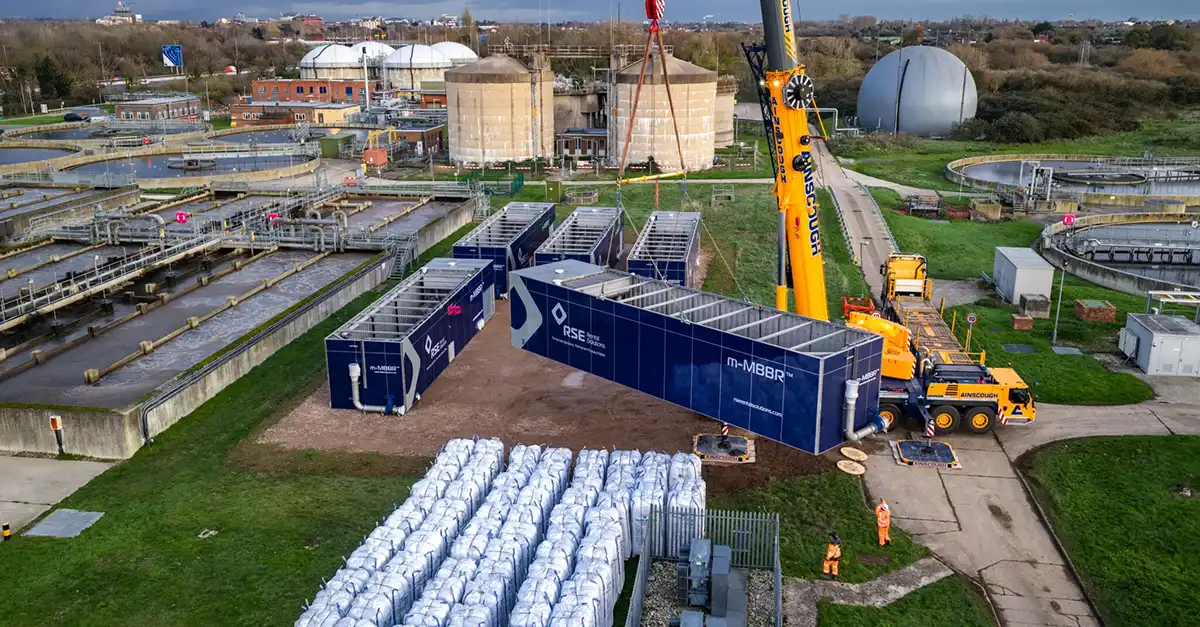
Yes. RO lends itself well to modular delivery, because the equipment is compact and repeatable. RSE builds, wires, pipes and tests complete skids or Transportable Treatment Units (TTU®) in our own facilities, then delivers them to site ready for connection.
What Monitoring and Automation Systems are Provided?
Every RSE plant includes full instrumentation for flow, pressure, conductivity, pH, temperature and turbidity, with PLC and SCADA control, automatic clean-in-place sequences, normalised performance trending, and remote access for alarms and diagnostics. We integrate with your existing telemetry and control standards.
Enquire Now
Speak to Our Team
Learn more about our business, products or services by completing the form, or alternatively fill in our public feedback form here.